Firefighter robot
Progress report. Last edited on 13 October 2026. The results date from 8 to 13 October 2026.
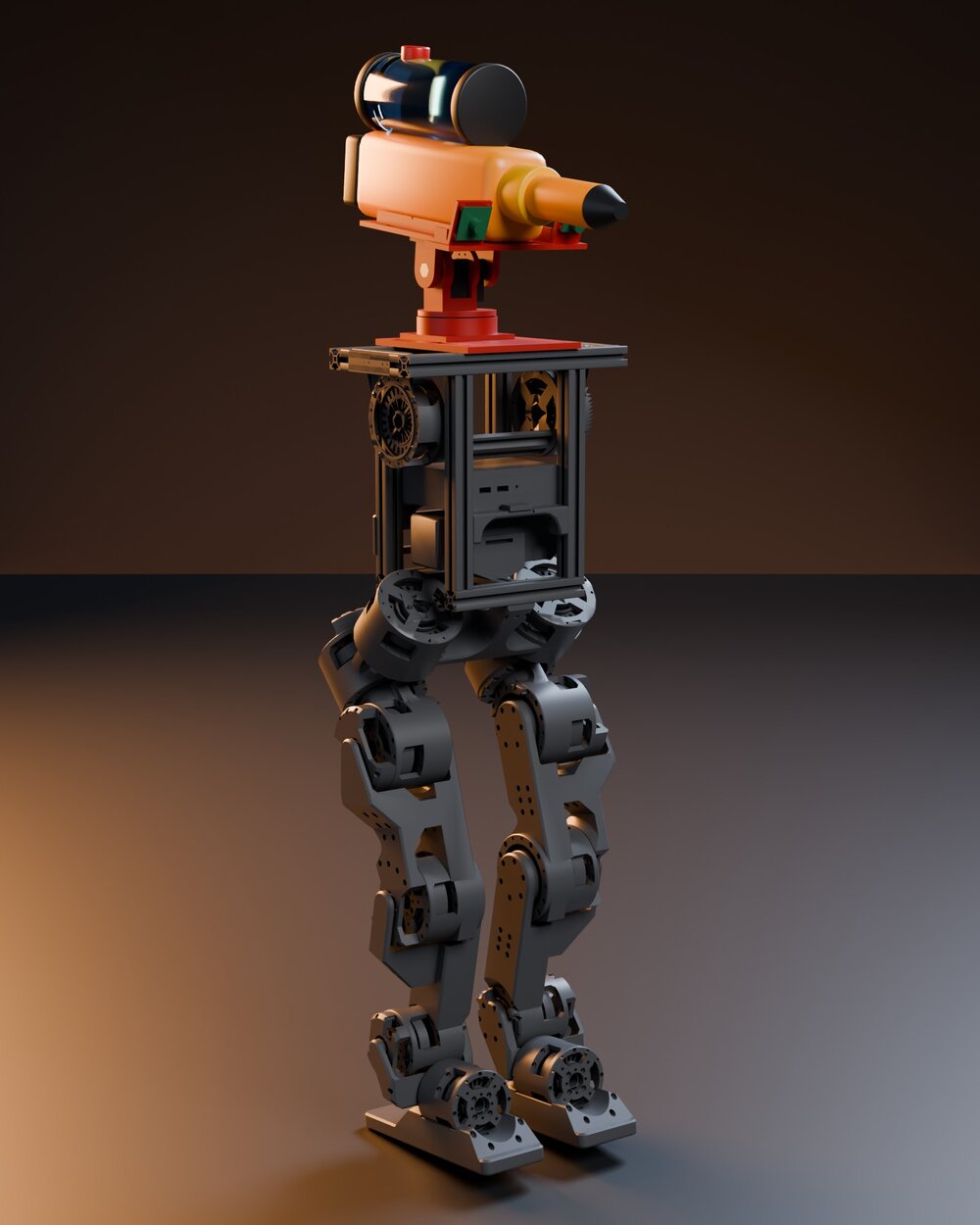
The firefighter robot walks to a small fire and puts it out with water. It uses the legs and the torso frame of the open-source Berkeley Humanoid Lite. A water gun or a small pump sits on top.
This page collects the work outside vision: the body, the payload, walking, the hardware, the aiming software and a test platform for the fire detector. Marc works on the fire detector, so this work stops at the interface to his detector.
Status
| Work package | Status | Main result | Folder |
|---|---|---|---|
| Body concepts | planned | Five concepts on the same legs. Concept A, a water gun on a pan-tilt, is the suggested first build. | cad/ |
| Payload on the legs | tested in simulation | The worst leg torque for A with the real CAD parts is 5.2 Nm. The policy limit is 6 Nm. | sim/payload/ |
| Official walking policy | tested in simulation | No fall with any payload at 6 Nm. At 4 Nm, concept B with a full bottle falls in under 1 s. | sim/sim2sim/ |
| Closed loop | tested in simulation | The robot found the fire, walked, aimed and put it out from 1.9 m. It did not fall. | sim/sim2sim/ |
| Our walking policy | tested in simulation | It turns on the spot at 0.39 rad/s. It is slower and less robust than the official policy. | sim/rl/ |
| Pump inside the torso | tested in simulation | Two printed tanks for a 33 g micropump: R1 inside the torso (0.63 L) and R2 on the sides (0.73 L). Both give the lowest centre of mass so far and walk like the bare robot. R1 is the suggested option. | cad/torso_tank/, sim/payload/ |
| Printable parts | planned | 25 parts with STEP and STL files: pan-tilt in 2 versions, adapters, splash guard, backpack and bench rig. | cad/parts/, cad/backpack/, cad/bench/ |
| Parts list | planned | 463,273 KRW plus Waveshare shipping. The lab limit is 500,000 KRW. | docs/hardware/ |
| Aiming code and drivers | tested in simulation | 45 tests pass. Nobody has run the code on real servos, a Pico or the robot. | aim/, actuators/ |
| Vision test platform | tested in simulation | 270 synthetic samples, a camera-in-the-loop simulator and six test scenarios. All scenarios pass. | sim/firescenes/, sim/sim2sim/ |
Body concepts planned
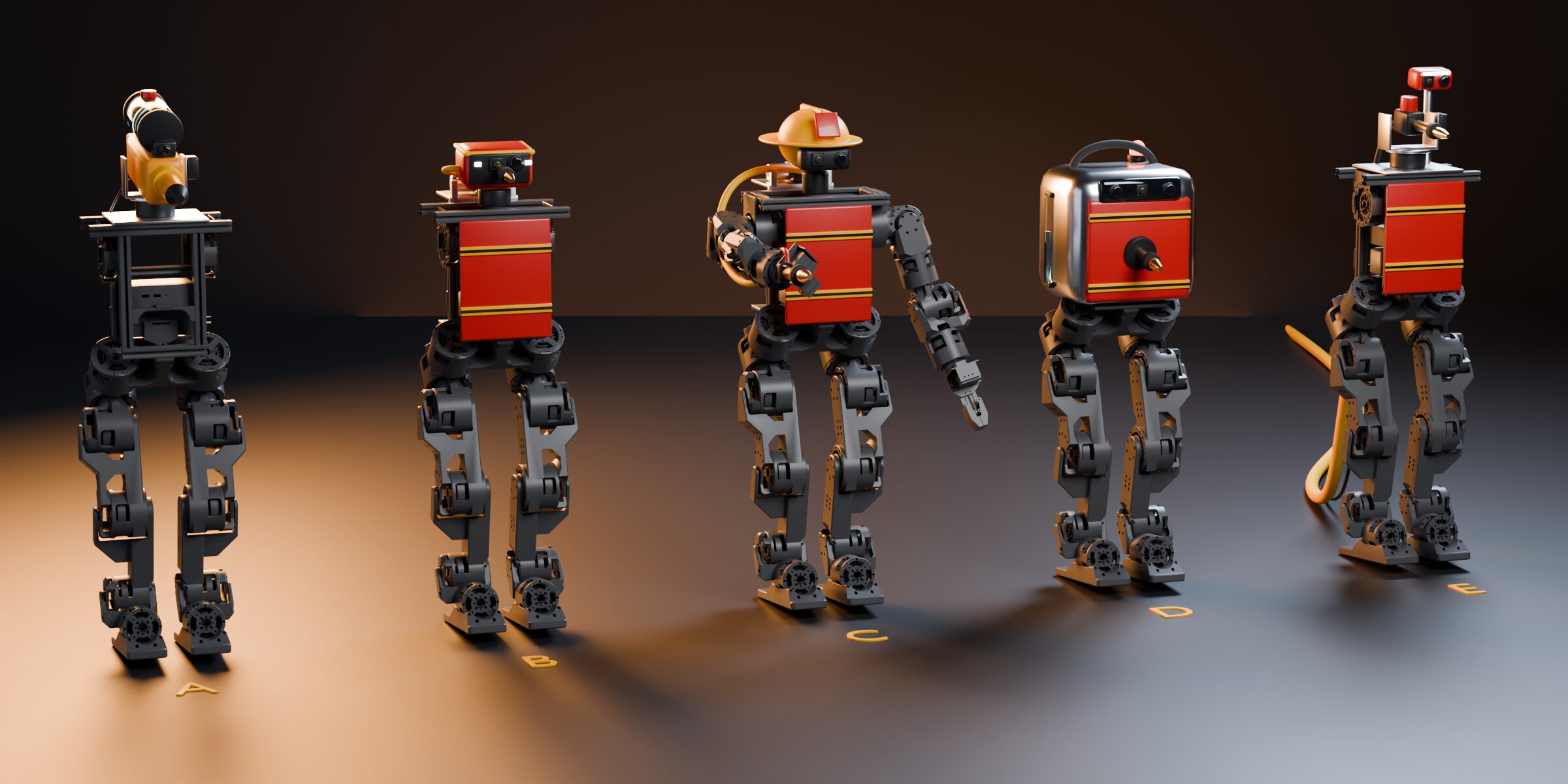
All five concepts keep the Berkeley legs and torso frame. They differ in the water source, the aiming method and what sits on top of the hips. The Body concepts article describes each concept with renders.
| Concept | Water | Aim | Added mass | Build effort |
|---|---|---|---|---|
| A Water gun turret | Gun tank, about 0.5 L | Pan-tilt, 2 servos | ~1.4 kg | Low |
| B Backpack pump | Tank and 12 V pump on the back | Head pan-tilt, 2 servos | ~2.7 kg | Medium |
| C Arm lance | 1 L tank and pump | Right arm, 5 motors | ~7.3 kg | High |
| D Sealed shell | About 1 L inside | Whole body | ~2.3 kg | Medium to high |
| E Tethered hose | External, no limit | Pan-tilt, 2 servos | ~1.0 kg | Low to medium |
We suggest concept A first, because it needs the least new work. The gun keeps its own tank and pump, and a relay switches its trigger. The same deck and 40 mm hole pattern can later take the camera head of B or the valve of E. The pump of concept B is the upgrade for range and flow.
Payload on the legs tested in simulation
We built MuJoCo models of the robot with the payload of each concept. We then computed the joint torques in slow poses with inverse dynamics. One-leg stance gives the highest torque, and it happens in every step.
| Model | Peak torque, one-leg stance |
|---|---|
| Biped, no payload | 4.3 Nm |
| A, first estimate | 5.9 Nm |
| A, real CAD parts | 5.2 Nm |
| B, first estimate | 3.6 Nm |
| B, real CAD parts, full bottle | 3.9 Nm |
| D | 6.0 Nm |
| E, 20 N hose pull | 5.2 Nm |
| C, with arms | 11.6 Nm |
- No concept reaches the 20 Nm motor limit in any slow pose.
- A and D sit at the 6 Nm policy limit. C, with arms, is far above it.
- With the real CAD parts, A drops to 5.2 Nm. Its gun now sits behind the tilt axis.
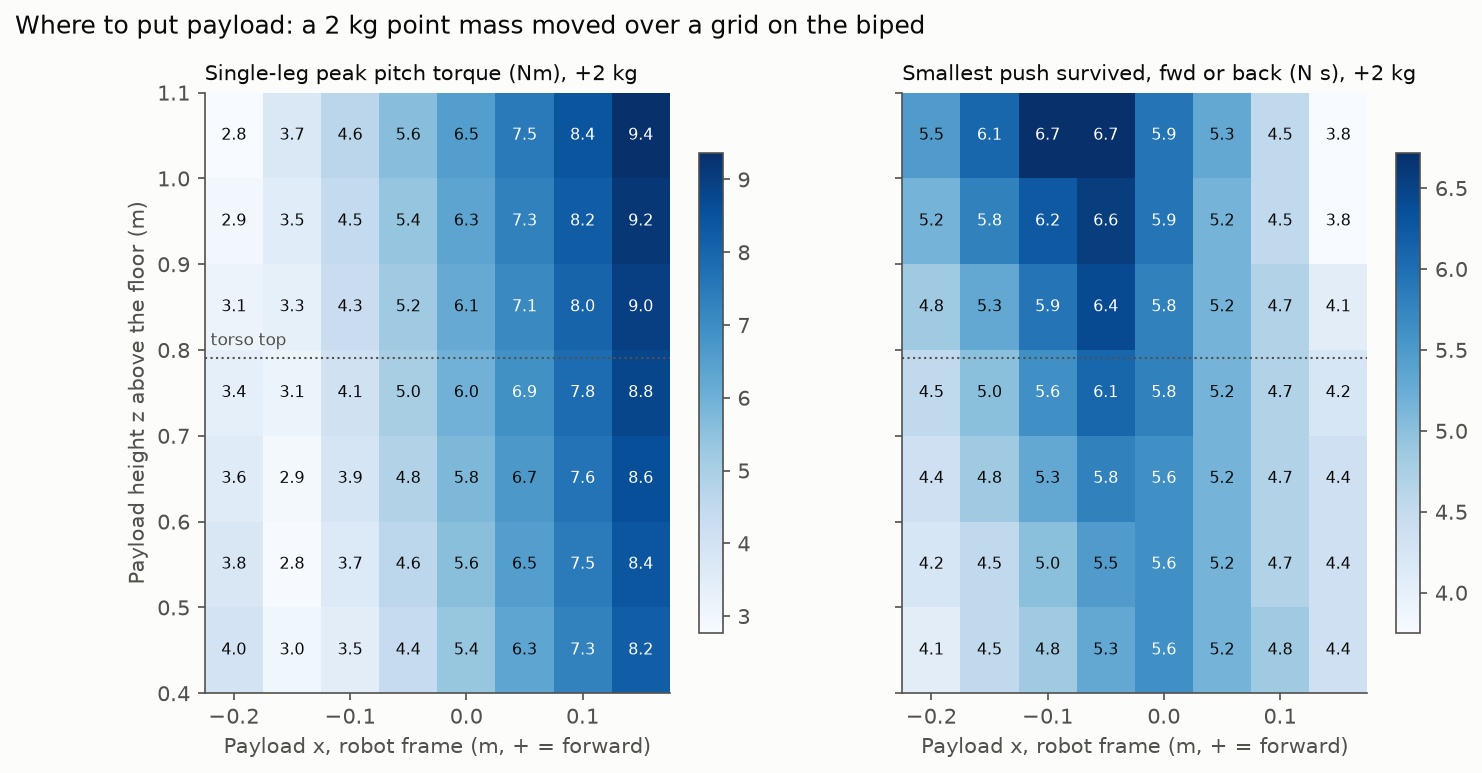
- Mass behind the torso costs less torque. 2 kg at x = −0.15 m costs 3–4 Nm. At x = +0.15 m it costs 8–9 Nm. Height matters little.
- The budget before 6 Nm is about 2 kg on the torso top, or 5.5 kg in the backpack zone.
- When the bottle empties, the centre of mass moves forward by about 1 cm.
Walking
Official policy with a payload tested in simulation
The Berkeley team ships trained walking policies. We ran policy_biped_25hz_a.onnx in our own MuJoCo loop with the payload models. Each test lasted 20 s.
- At 6 Nm, no model fell in any test. B with a full bottle walks slowly, at 0.11–0.16 m/s.
- At 4 Nm, the default of the Berkeley runtime, B with a full bottle falls in under 1 s. We must run the robot at 6 Nm.
- The policy does not turn on the spot. For 0.5 rad/s asked, it turns at 0.06 rad/s. With 0.2 m/s forward, the turn works.
- Below 0.25 m/s the policy often stands still. So the aiming code walks at 0.25 m/s or faster.
Closed loop: see, walk, aim, spray tested in simulation
We joined the official policy at 6 Nm, our aiming code and concept A with the real CAD parts in one MuJoCo run.
- A virtual camera on the gun makes noisy detections at 10 Hz.
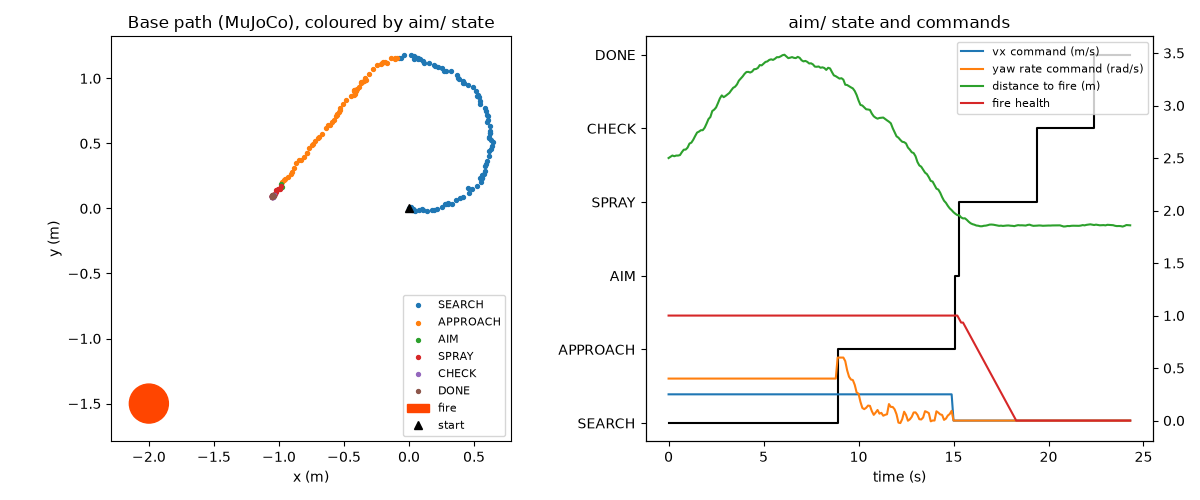
- The fire sat 2 m behind and 1.5 m to the right. The aiming code walked an arc to find it. It then aimed with the pan-tilt.
- The robot sprayed at 15.3 s, 1.9 m from the fire. The fire went out. The robot did not fall.
Torque limit and motor heat tested in simulation
| Quantity, walking at 6 Nm, A and B with real parts | Value |
|---|---|
| Highest RMS joint torque | 3.8 Nm |
| Copper loss per motor (estimate from the Berkeley resistance and torque constant) | 0.4–2.4 W |
| Time a joint is above 4 Nm | 47 % |
- At 4 Nm, concept A falls after 4.5 s and concept B after 0.9 s. So 4 Nm is not an option with a payload.
- The hottest joint is the ankle pitch, with up to 4.4 Nm RMS when standing. Hip yaw and hip roll come next.
Our policy tested in simulation
We trained our own policy with MuJoCo Playground on the RTX 3090. During training, a payload of 0 to 2.5 kg sits on the torso. Each run took 16 to 37 min.
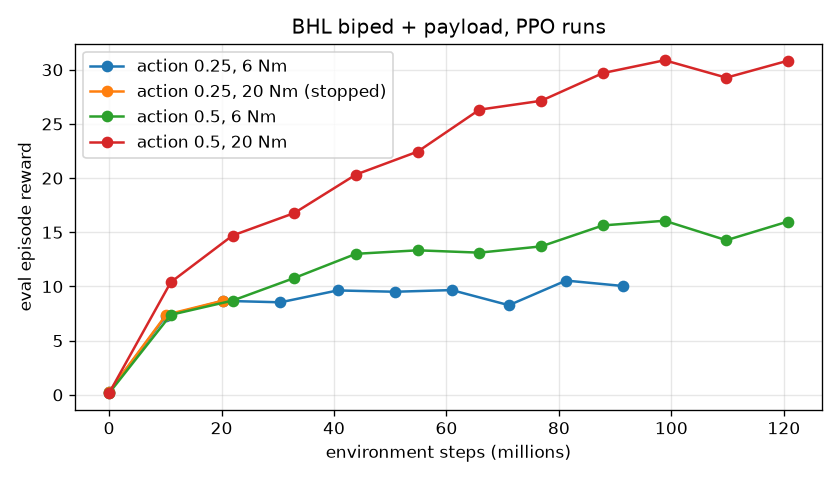
| Training setup | 0 kg | 1.5 kg | 3.5 kg |
|---|---|---|---|
| 6 Nm, payload 0–2.5 kg | 29 % | 42 % | 59 % |
| 6 Nm, payload 0–3.5 kg, knee ≤ 1.4 rad | 43 % | 48 % | 61 % |
| 20 Nm, payload 0–2.5 kg | 1 % | 3 % | 10 % |
- Without pushes, the policies walk at 0.3 m/s with 0–2 % falls.
- More torque helps far more than wider training ranges. We must learn the real motor limit.
A policy that turns on the spot tested in simulation
We trained a second policy with the same interface as the official policy: 45 inputs, 12 outputs, 25 Hz. Its ONNX file can replace theirs. We tested both with the same harness, with the training noise on.
| Concept A, real parts, 6 Nm | Ours | Official |
|---|---|---|
| Walk, 0.25 m/s asked | 0.15 m/s | 0.23 m/s |
| Turn on the spot, 0.5 rad/s asked | 0.39 rad/s | 0.04 rad/s |
| Walk and turn (m/s, rad/s) | 0.17, 0.44 | 0.23, 0.48 |
| Falls with pushes, of 10 | 8–9 | 5–7 |
| Concept B, 2.8 kg | falls | walks |
Our policy turns on the spot, which the official policy cannot do. But it walks slower, falls more under pushes and falls with concept B. It is not ready. The next step is a longer training with pushes and heavier payloads.
Hardware
Pan-tilt module planned
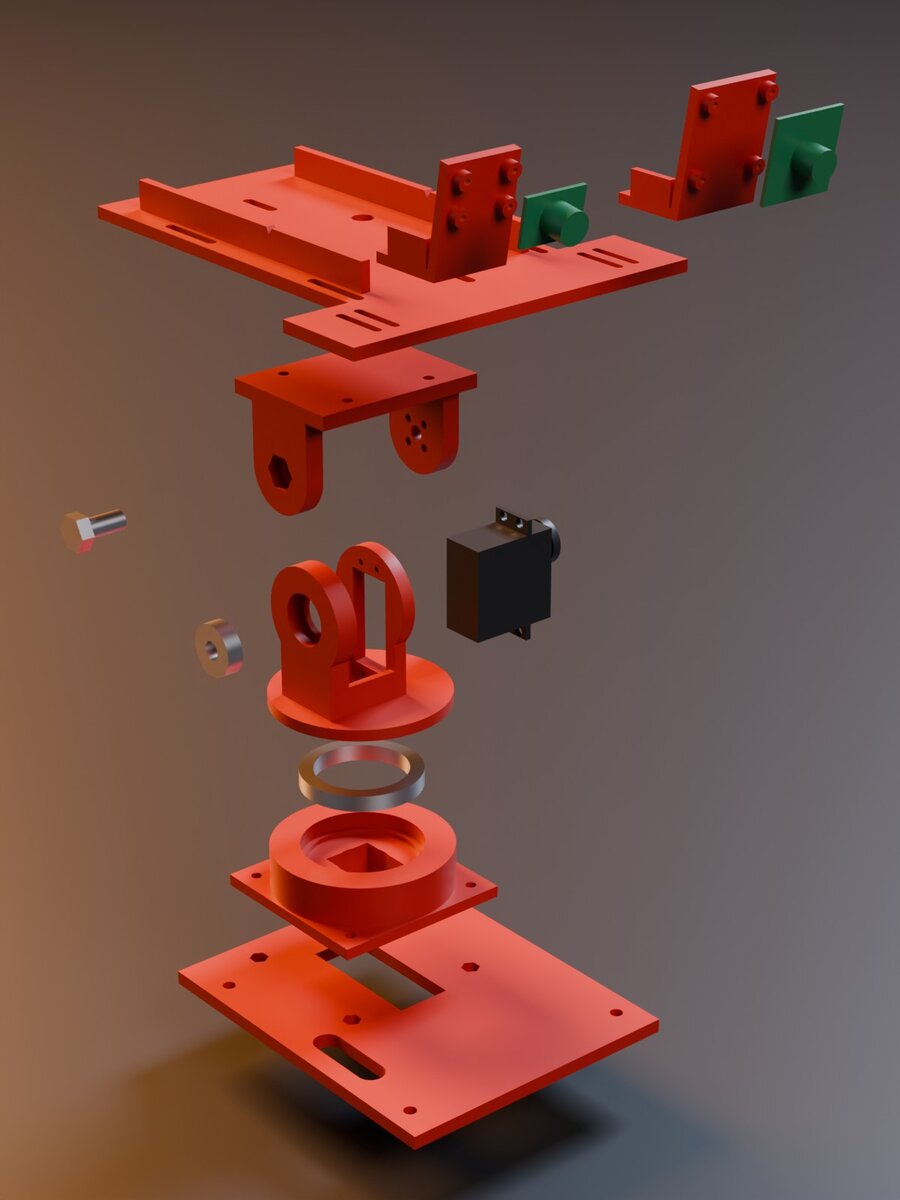
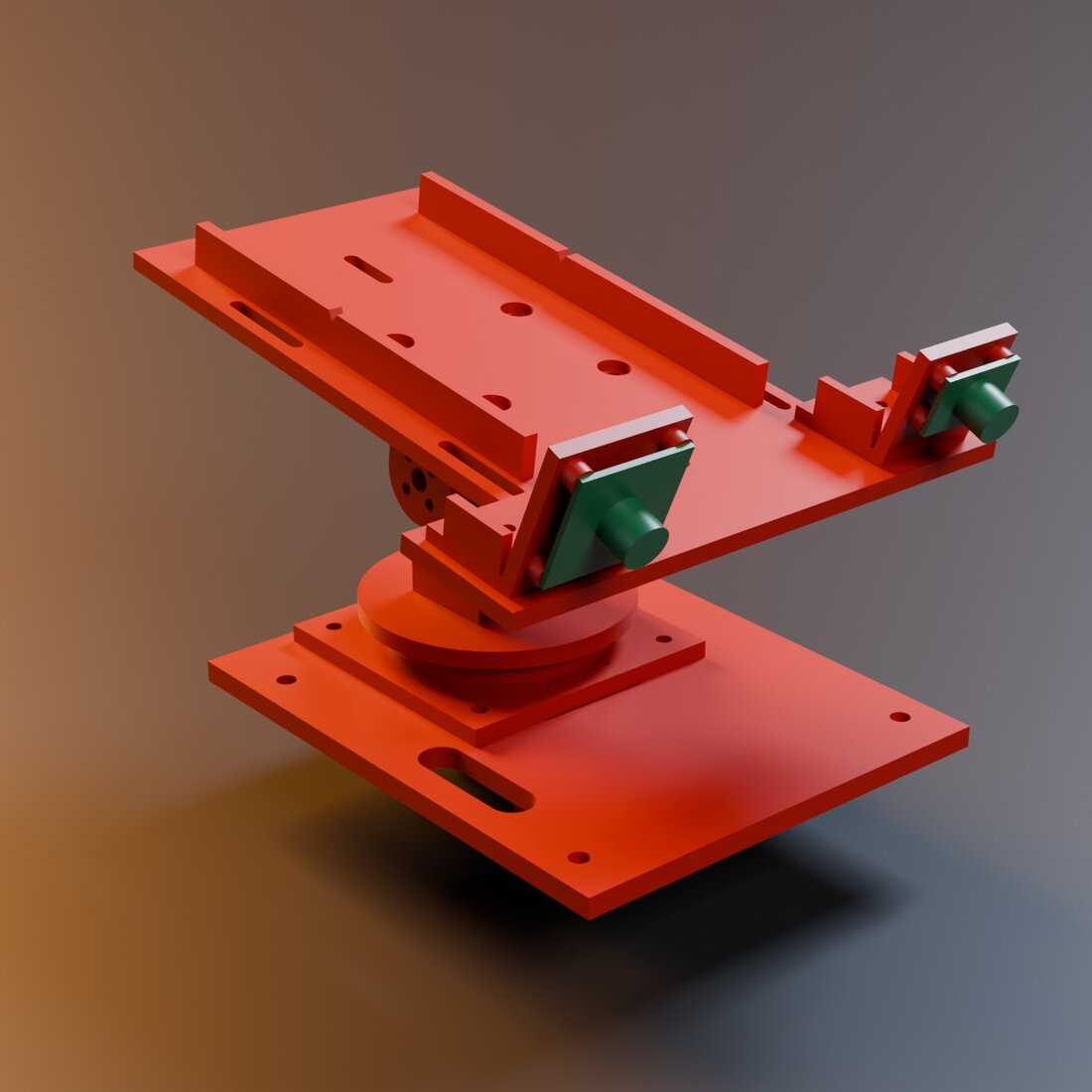
- The deck bolts to the two 2020 rails of the torso top, at x = ±60 mm, with 4 M5 T-nuts.
- The pan axis turns on a 6808 bearing, so the servo carries no load.
- The gun centre of mass is 22 mm behind the tilt axis, at x = −0.060 m.
- The ST3215 version uses 312 g of PLA. Its servos report their position and load.
- The 4 × M4 hole pattern on a 40 mm square can later take the camera head of B or the valve of E.
Adapters, splash guard and backpack planned
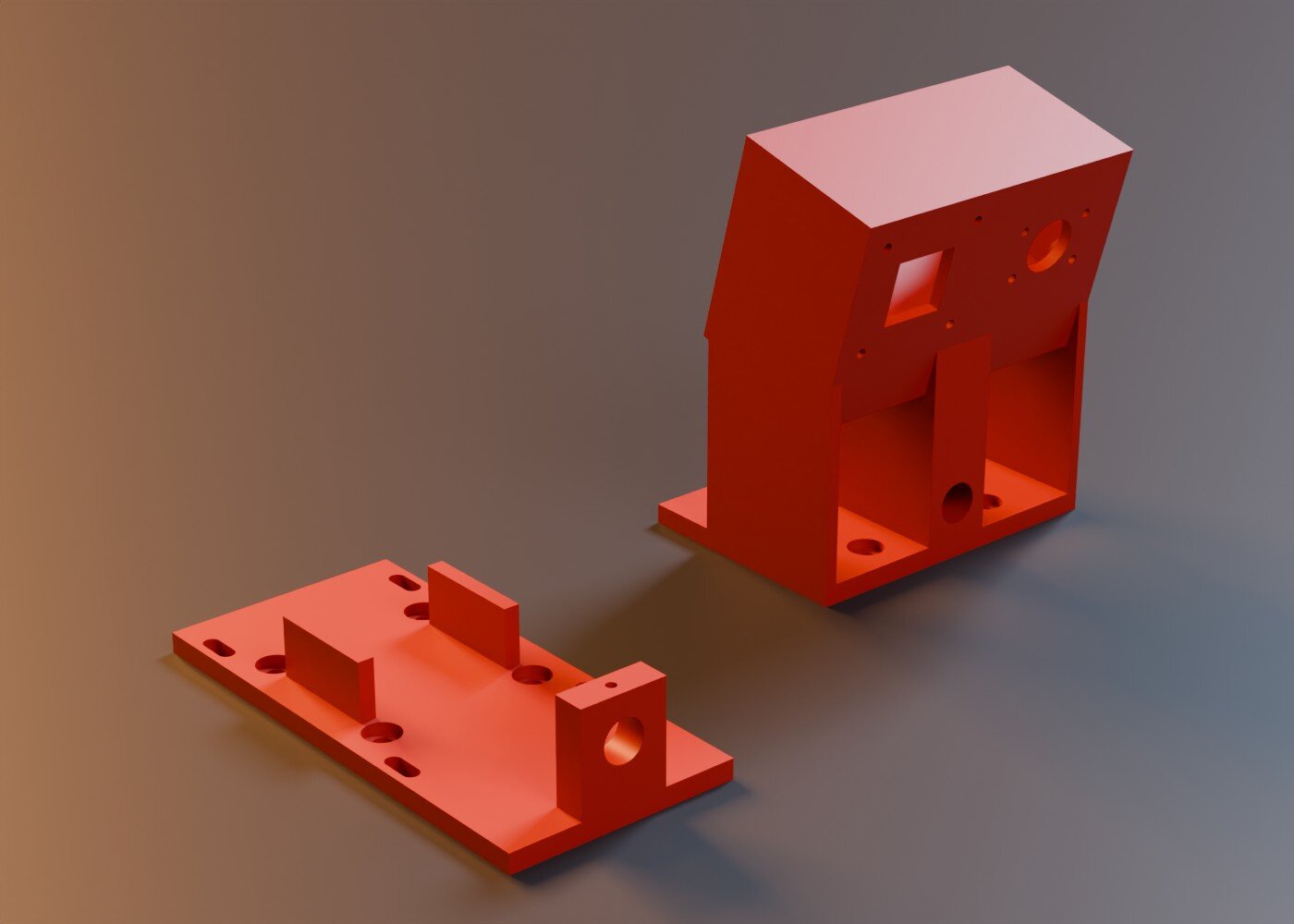
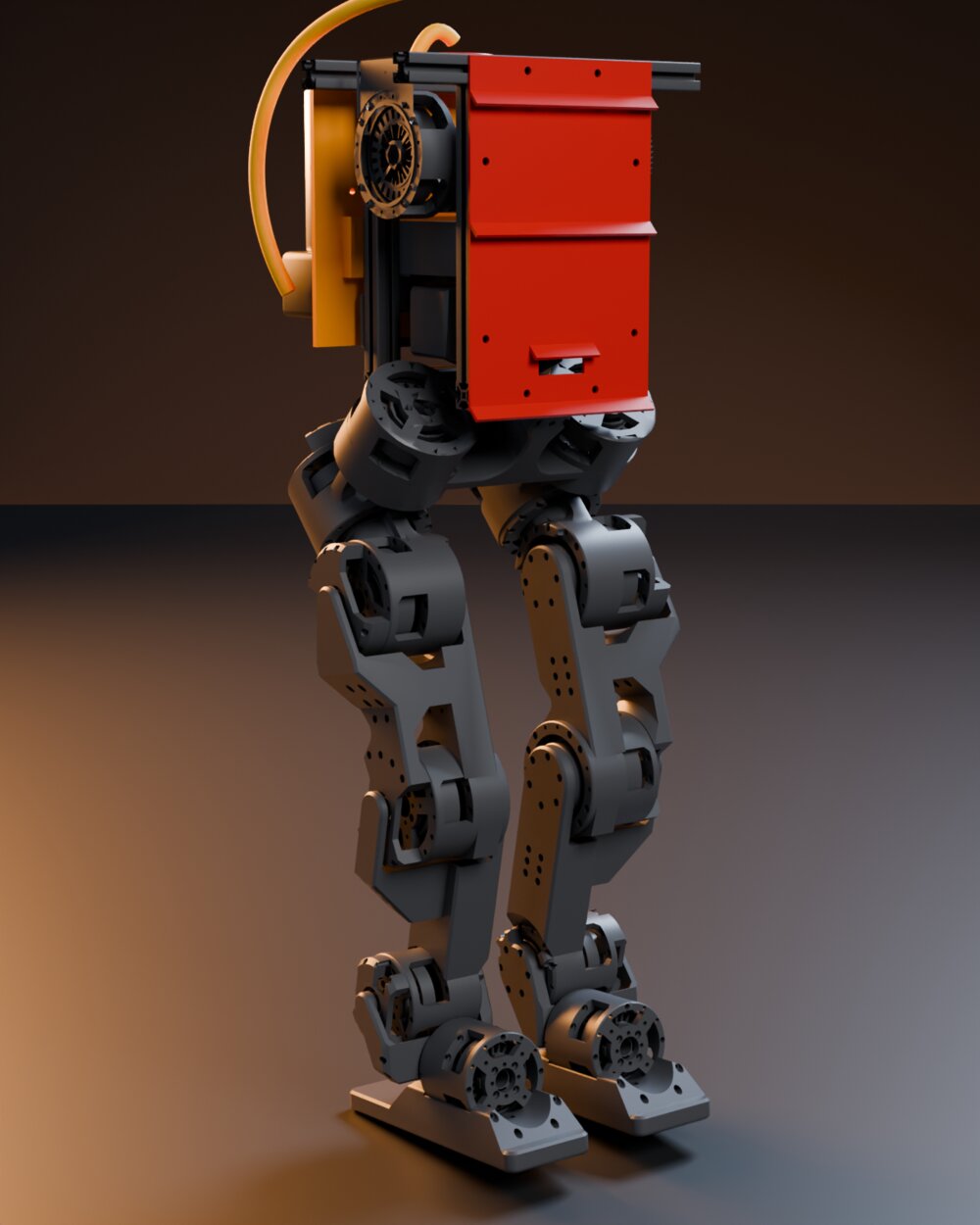
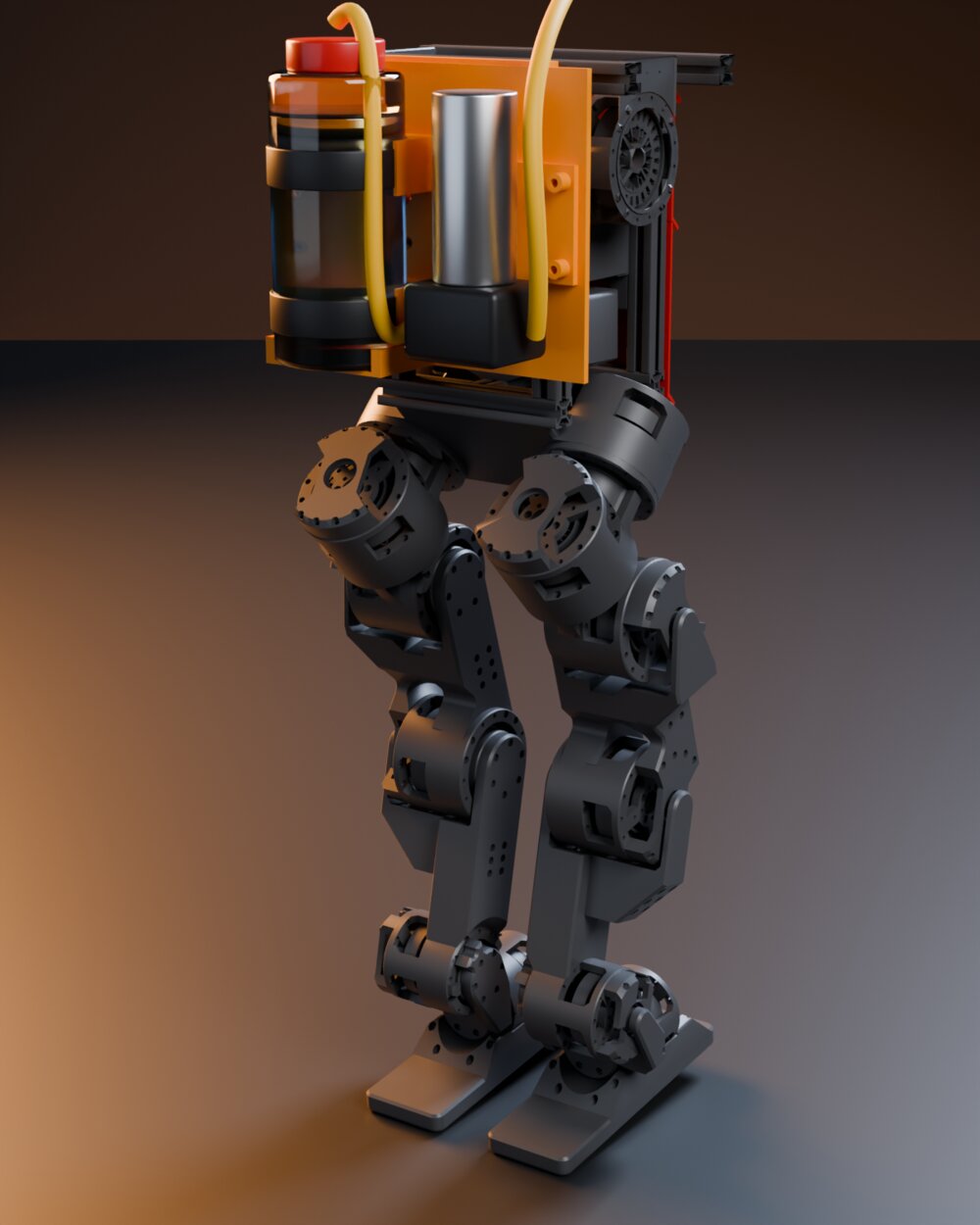
- The B head puts the nozzle 62 mm under the cameras, so the nozzle never blocks the image.
- The backpack holds a 1 L Nalgene bottle and a Seaflo 12 V pump.
Bench rig planned
The bench rig lets us test the module, the water and the aiming before the robot walks.
- Two 140 mm 2020 rails at x = ±60 mm take the same deck as the robot.
- The base clamps to a table or sits on a tripod (1/4"-20). A tray holds the bottle and the pump. A box holds the electronics and the e-stop.
- The tipping margin is 50 mm or more with the gun turned and a full bottle.
- The rig uses about 988 g of PLA.
The test plan is in cad/bench/README.md:
- Calibrate the servos.
- Measure the jet speed.
- Align the camera with the nozzle.
- Aim at paper targets.
- Put out a small fire outdoors.
Parts list planned
The parts list covers the water system, the aiming and the safety parts. The lab pays. 3D-printed parts cost nothing, because the lab has printers. The lab already has the motors and all other parts of the Berkeley robot. The cameras belong to the vision budget.
The total is 463,273 KRW with VAT, plus the Waveshare shipping. The lab limit is 500,000 KRW.
| Group | KRW |
|---|---|
| Water | 165,156 |
| Aiming | 126,776 |
| Electronics | 103,740 |
| Safety | 44,671 |
| Wiring | 22,930 |
| Total | 463,273 |
| Group | Item | Qty | Total (KRW) | Shop | Price |
|---|---|---|---|---|---|
| Water | Seaflo SFDP1-010-040-21 12 V diaphragm pump (3.8 L/min, 0.28 MPa), 1 + 1 spare | 2 | 72,600 | Devicemart | price of 8 Oct |
| Nalgene 1 L wide-mouth bottle (fits the printed cradle) | 1 | 27,000 | Kolon Mall | checked 9 Oct | |
| Braided PVC hose, 8 mm inner diameter, per metre | 3 | 3,300 | Devicemart | price of 8 Oct | |
| Brass fitting, PT 1/4 male to 8 mm barb (hose to nozzle) | 2 | 3,718 | NaviMall | checked 9 Oct | |
| Brass coupling, PT 1/4 female-female | 1 | 1,529 | NaviMall | checked 9 Oct | |
| Hose clamp, 8–12 mm | 6 | 1,980 | NaviMall | checked 9 Oct | |
| Sanga SJN02 solid-stream nozzle, PT 1/4, 2 mm orifice (pack of 10) | 1 | 21,989 | NaviMall | checked 9 Oct | |
| Daiso electric water gun (about 100 mL, first test) | 1 | 5,000 | Daiso Mall | checked 9 Oct | |
| Rechargeable electric water gun, 400 mL (demonstration) | 1 | 28,040 | 11st | checked 9 Oct | |
| Aiming | Waveshare ST3215 12 V serial bus servo (30 kg·cm), pan and tilt | 2 | 58,212 | Waveshare | USD × 1,400 |
| Waveshare Bus Servo Adapter (A), USB to servo bus | 1 | 6,986 | Waveshare | USD × 1,400 | |
| 6808 bearing (40 × 52 × 7 mm), pan axis | 1 | 17,589 | NaviMall | checked 9 Oct | |
| M5 T-nuts for 2020 profile (pack of 100) | 1 | 25,289 | NaviMall | checked 9 Oct | |
| M3 × 4 mm heat-set inserts (pack of 50) | 1 | 11,880 | ICbanq | checked 9 Oct | |
| M4 brass inserts | 20 | 6,820 | NaviMall | checked 9 Oct | |
| Electronics | DC-DC converter, 20–96 V to 12 V, 10 A, waterproof | 1 | 31,790 | ICbanq | checked 9 Oct |
| Raspberry Pi Pico 2 (relay control) | 1 | 12,100 | ICbanq | checked 9 Oct | |
| 2-channel 5 V relay module (channel 1: gun trigger, channel 2: pump) | 1 | 1,760 | ICbanq | checked 9 Oct | |
| SB560 Schottky diode (pump flyback) | 5 | 1,870 | ICbanq | checked 9 Oct | |
| NEXT UH305 powered USB 3.0 hub | 1 | 26,300 | 11st | checked 9 Oct | |
| Adafruit 3626 DC power meter (100 V, 20 A), to measure the current | 1 | 29,920 | ICbanq | checked 9 Oct | |
| Safety | 22 mm latching e-stop, 2 NO + 2 NC (KSEP2260-22) | 1 | 16,280 | ICbanq | checked 9 Oct |
| Power relay, 24 V coil, 30 A | 1 | 1,760 | ICbanq | checked 9 Oct | |
| Inline blade fuse holder | 1 | 792 | ICbanq | checked 9 Oct | |
| Blade fuse, 10 A | 5 | 2,475 | ICbanq | checked 9 Oct | |
| Blade fuse, 5 A | 5 | 2,475 | ICbanq | checked 9 Oct | |
| ABC powder extinguisher, 3.3 kg (for the tests) | 1 | 20,889 | NaviMall | checked 9 Oct | |
| Wiring | XT30 connector pair (tap on the robot 24 V bus) | 5 | 6,600 | ICbanq | checked 9 Oct |
| XT60 connector pair | 2 | 6,380 | ICbanq | checked 9 Oct | |
| Silicone cable 16 AWG, per metre (2 m red + 2 m black), plus 2,800 KRW shipping | 4 | 5,000 | 11st | checked 9 Oct | |
| DC jack 5.5 × 2.1 mm with cable | 2 | 1,100 | Eleparts | checked 9 Oct | |
| Dupont wires (65 pieces) | 1 | 1,320 | ICbanq | checked 9 Oct | |
| Heat-shrink tubing (100 pieces) | 1 | 2,530 | ICbanq | checked 9 Oct | |
| Optional, not in the total | 22 AWG UL1007 wire kit | 1 | 23,100 | Eleparts | checked 9 Oct |
| Third ST3215 servo as a spare | 1 | 29,106 | Waveshare | USD × 1,400 | |
| ST3215 from a Korean shop (if the order from abroad is a problem) | 1 | 74,789 | NaviMall | checked 9 Oct | |
| KITZ 3/8" Y-strainer for the pump inlet (heavy) | 1 | 45,089 | NaviMall | checked 9 Oct |
docs/hardware/bom_extinction.csv.Power and wiring planned
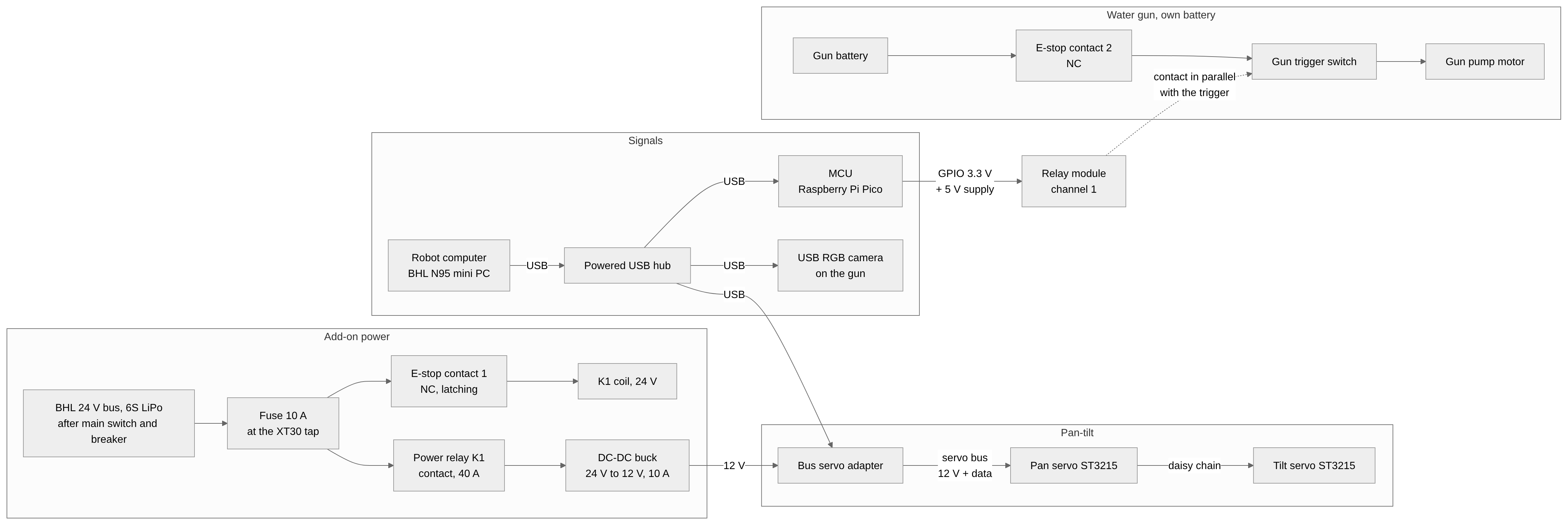
Power comes from the robot's 24 V bus through a 10 A fuse, an e-stop relay and a 24 V to 12 V converter. The e-stop cuts all add-on power. It does not stop the leg motors.
# Pico 2 pins
GP14 -> relay IN1   water-gun trigger
GP15 -> relay IN2   12 V pump
GP16 <- e-stop NC   open = stop

# Servo ids
1 = pan, 2 = tilt
Software
Overview tested in simulation
cameras --images--> fire detector (Marc)
                         |
                         |  UDP 5600: detections
                         v
robot pose --UDP 5605--> aim/run.py --UDP 5601: pan, tilt, water--> actuator_node.py --> servos, pump, gun
                         |    ^                                         |
                         |    +------- UDP 5603: measured angles -------+
                         |
                         +--UDP 5602: vx, yaw rate--> walk_bridge.py --> Berkeley walking policy
Every message is one JSON line over UDP on the robot computer. The detector sends only pixel positions and boxes. The aiming code computes the fire position, the jet angles and the walk command.
Detector interface
Version 1, the current interface: the detector sends one JSON line for each fire and frame to 127.0.0.1:5600.
{"timestamp": 12345.678, "camera": "rgb", "u": 331.5, "v": 298.0,
 "bbox": [310, 280, 352, 316], "confidence": 0.87,
 "max_temp_c": null, "depth_m": null}
The timestamp is time.monotonic() on the robot computer at the time of the image.
Version 2, a proposal: the detector sends one frame message for each camera image, also when it sees no fire. An empty list means that the image has no fire.
{"timestamp": 12345.678, "camera": "rgb", "frame": true,
 "detections": [{"u": 331.5, "v": 298.0, "bbox": [310, 280, 352, 316], "confidence": 0.87}]}
With version 1, aim/run.py cannot tell "no fire in this image" from "the image is late". The software-in-the-loop test found 9 to 24 % of controller ticks without a new image. aim/run.py accepts both versions.
Questions for Marc:
- Q1. Does the detector correct the lens distortion?
- Q2. Which point is (u, v): the box centre, the hottest pixel or the base of the flame? The aiming code assumes that the fire touches the floor at (u, v).
- Q3. Which cameras, image sizes and fields of view do you use?
- Q4. What frame rate and what delay does the detector have?
- Q5. Can the detector send one frame message for each image (version 2)?
Aiming code tested in simulation
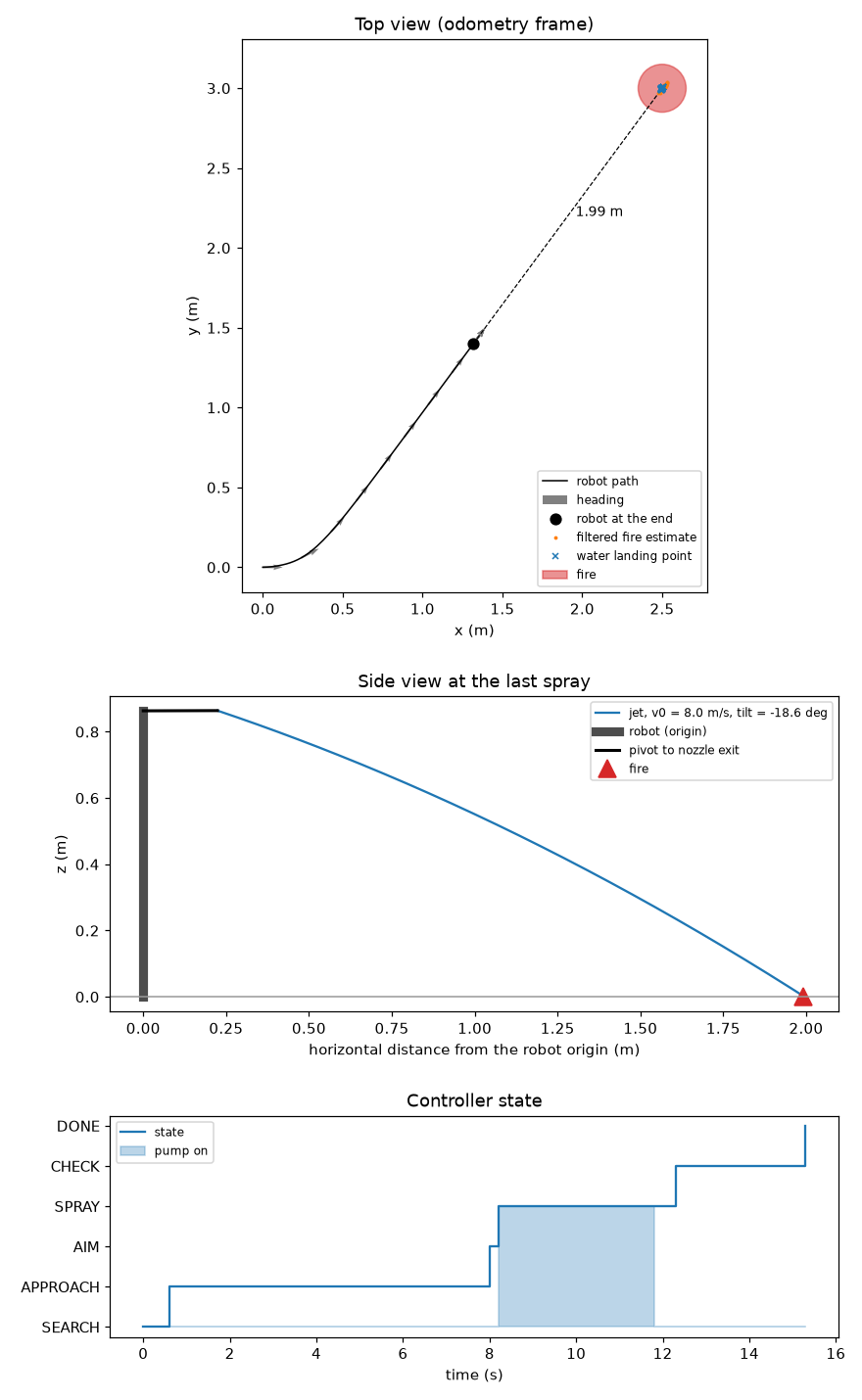
The aiming code starts where the detector stops. It finds the fire on the floor, walks closer, aims the jet and decides when to spray.
- The states are search, approach, aim, spray, check and done.
- A Kalman filter smooths the fire position and rejects outliers.
- The jet solver allows for the nozzle offset and, if wanted, air drag. It takes 0.35 ms (measured on laptop).
- The code uses the pan-tilt angles at the time of the image. A 100 ms delay then gives 0.25 mm of error instead of 9 cm.
- It sprays only with a recent, confident detection inside the jet range.
- An interlock stops the pump above 15° of torso tilt or 30°/s of tilt rate.
- 35 tests pass.
aim/send_test_detections.py sends fake detections to aim/run.py.Actuator drivers tested in simulation
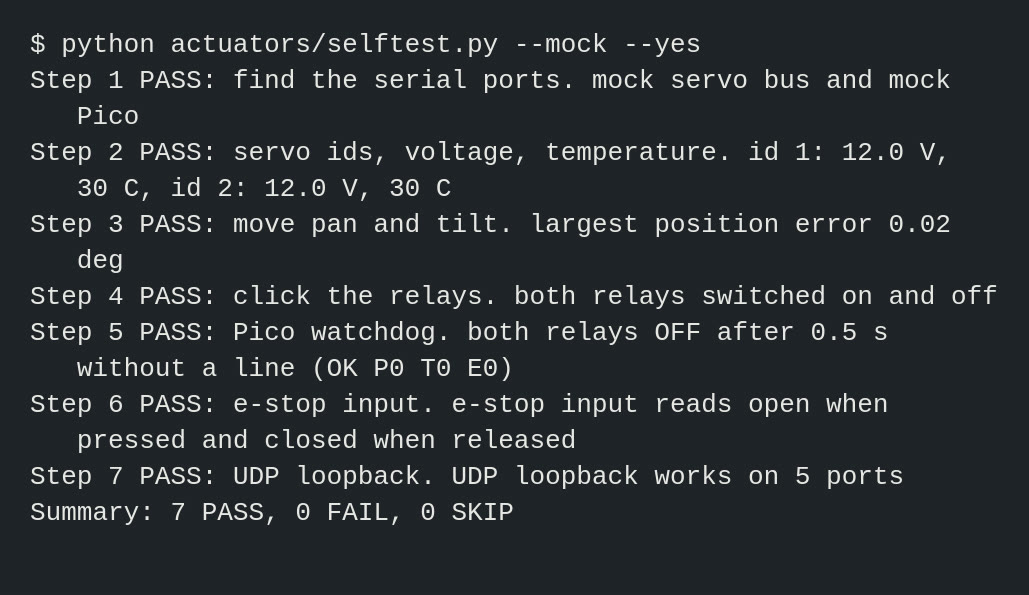
st3215.py- Driver for the Feetech STS servos. The tests use the packet examples from the Feetech manual.
pico_fw/main.py- Relay firmware for the Pico 2. The gun and the pump switch off after 0.5 s without a message, or when the e-stop opens.
actuator_node.py- Sends the aim commands to the servos and relays. Sends the measured angles back on UDP 5603. A mock mode runs without hardware.
walk_bridge.py- Replaces the Berkeley gamepad input. Sends a zero command after 0.5 s without a message.
selftest.py- 7 checks for the first day with the parts: ports, servos, relays, watchdog, e-stop and UDP. It asks before every move.
The full chain runs in mock mode: test detections, aiming, actuators, then done after 3.3 s of water. 10 tests pass.
Test platform for vision
We have no robot and no bench to test the fire detector on yet. These tools let Marc test the detector with the aiming code before the hardware exists.
Camera views tested in simulation
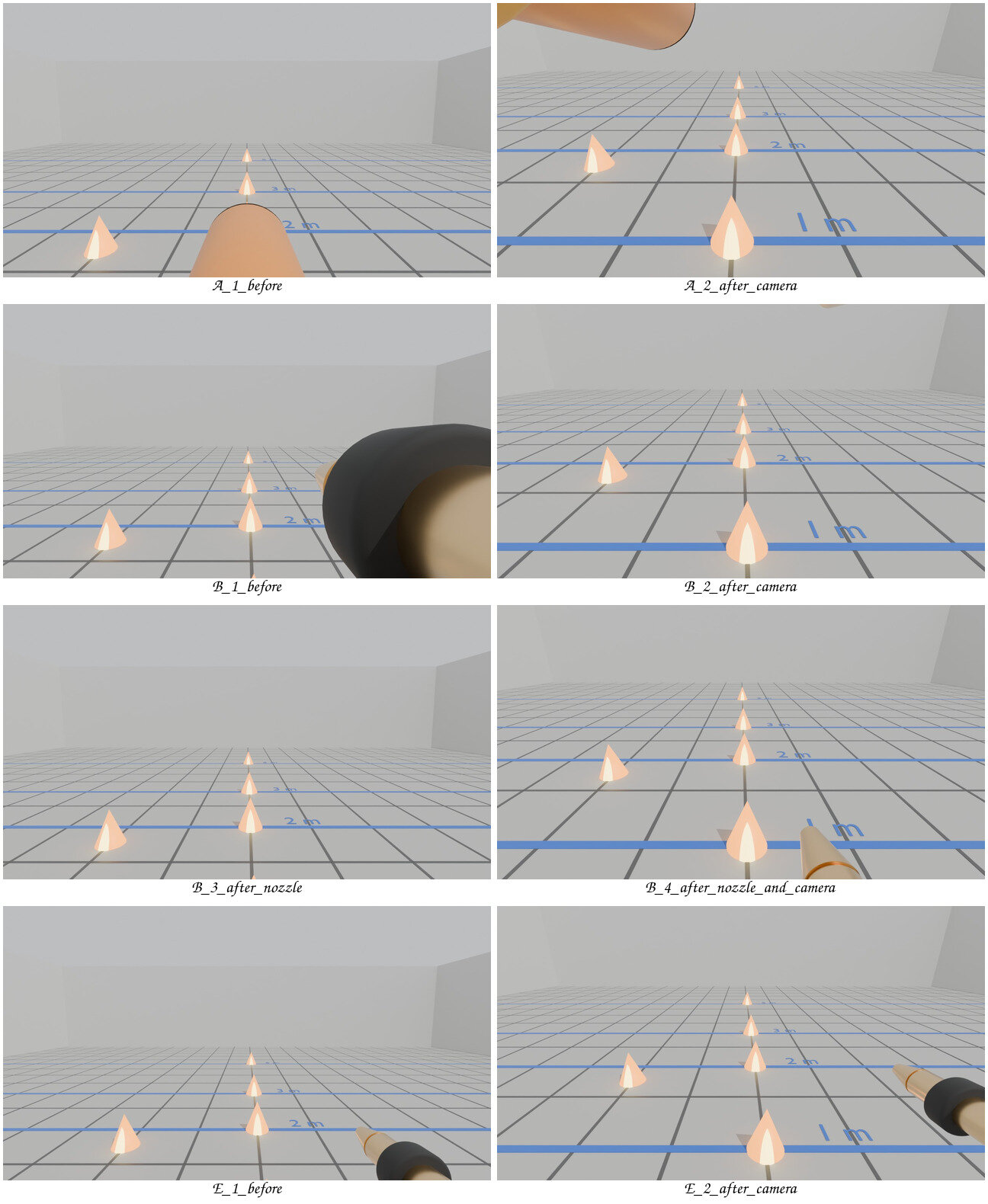
We rendered the view of each robot camera in a test room with fires at 1, 2, 3 and 5 m. We also computed how many pixels a 20 cm fire covers for each sensor.
| Sensor | 1 m | 3 m | 5 m | 8 m |
|---|---|---|---|---|
| MLX90640, 55°, 32 × 24 | 6 × 10 | 2 × 3 | 1 × 2 | 1 × 1 |
| Lepton 3.5, 160 × 120 | 30 × 37 | 10 × 12 | 6 × 7 | 4 × 5 |
| 256 × 192 USB thermal | 48 × 63 | 16 × 21 | 10 × 13 | 6 × 8 |
| RGB 1280 × 720, 90° | 128 × 160 | 43 × 53 | 26 × 32 | 16 × 20 |
- Below about 3 × 3 pixels, detection gets unreliable. This is a rule of thumb, not a measured limit.
- Small moves fix the view of concept A: the lens 4 cm to the side and 8 cm down, pitched 16° down. The floor is then visible from 0.8 m to 5 m.
- A 60° lens cannot see the floor closer than about 0.9–1.0 m.
Synthetic fire scenes tested in simulation
- 270 samples from the concept A camera pose: rooms and outdoor ground, 1–3 fires, lamps, people and smoke. 20 samples have the gun barrel in view.
- Each sample has an RGB image (1280 × 720), a thermal-like image at 3 resolutions, YOLO boxes and the 3D fire position.
- The projected fire centre falls inside its box in 98 % of the samples. The thermal values go up to 6553 K without clipping.
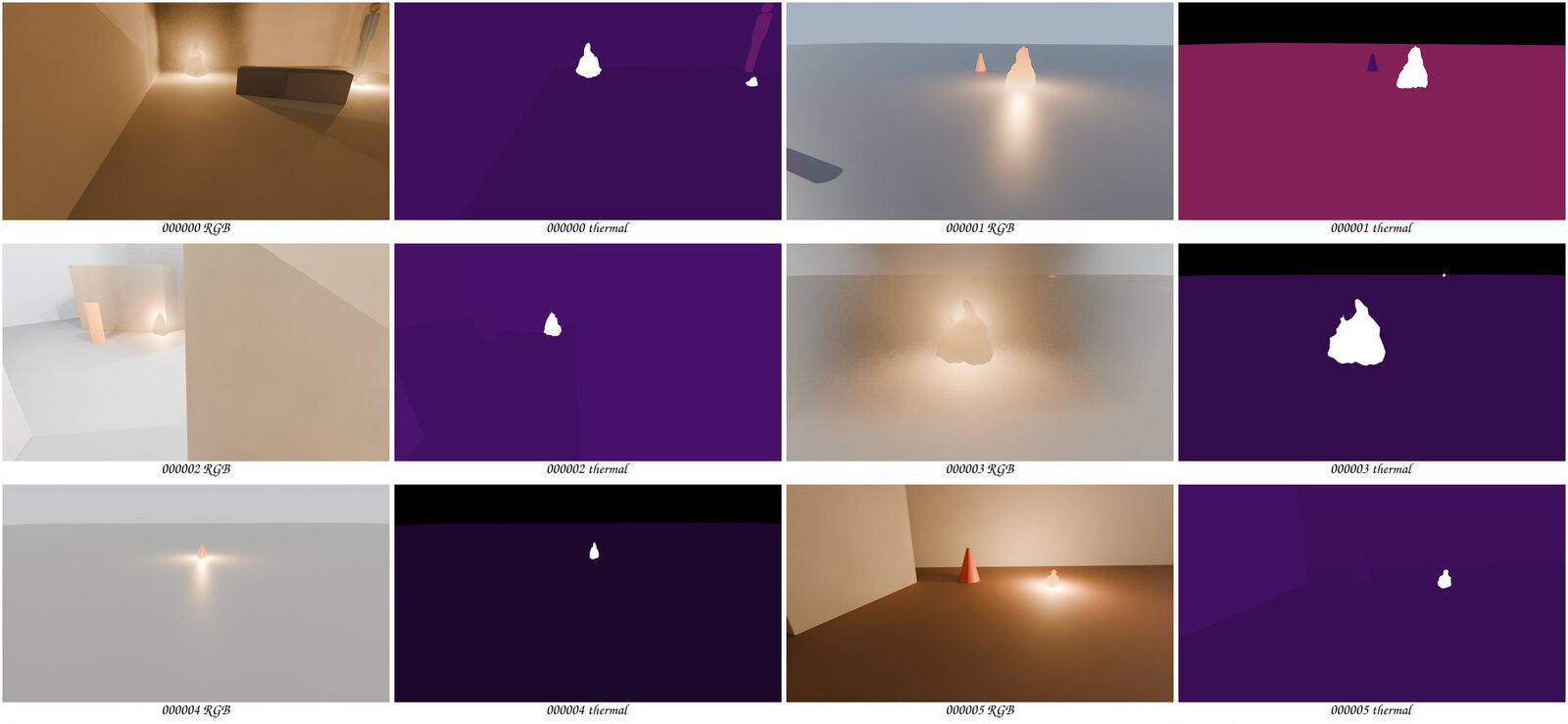
To make more samples, for example numbers 250 to 749:
blender -b --factory-startup -P sim/firescenes/firescenes.py -- samples 250 750
Camera in the loop tested in simulation
Every 100 ms the simulator renders the gun camera and calls detect(image, t). The detector output goes to the aiming code, and the robot walks and sprays in MuJoCo.
- The baseline detector is a colour threshold, not a real detector. With it, the robot sprayed at 6.9 s, and the jet landed 0.10 m from the fire. The robot did not fall.
- The baseline made 39 false detections on a warm lamp and none on a red box. The aiming code could not place the lamp on the floor, so it did not spray.
- The test found two aiming bugs. A second fire was ignored, and the tilt crept down while idle. We fixed both and added a test for each.
To plug in a detector:
- Write a Python file with a function
detect(rgb, t)that returns a list ofFireDetection(aim/detection.py). - Run the scenario suite with
--detectorand the path of that file.
MUJOCO_GL=egl sim/sim2sim/.venv/bin/python sim/sim2sim/camera_loop.py --quick --detector path/to/my_detector.py
from detection import FireDetection  # camera_loop.py puts aim/ on the import path


def detect(rgb, t):
    """rgb: 480 x 640 x 3 uint8 RGB image of camera "rgb". t: time of the image, s."""
    boxes = my_model(rgb)  # list of (u_min, v_min, u_max, v_max, score)
    return [FireDetection(t, "rgb", (u0 + u1) / 2, v1, (u0, v0, u1, v1), score)
            for u0, v0, u1, v1, score in boxes]
cv2.cvtColor(rgb, cv2.COLOR_RGB2BGR). The camera intrinsics are fx = fy = 320 px, cx = 320 px and cy = 240 px.Test scenarios tested in simulation
| Scenario | Result | Fire out at |
|---|---|---|
| Fire ahead, 2.5 m | pass | 7.3 s |
| Fire behind and to the right | pass | 18.9 s |
| Two fires | pass | 10.0 s and 38.3 s |
| Lamp only, no fire | pass | no spray |
| Fire 0.5 m in front | pass | 7.0 s, one spray |
| Fire 6 m away | pass | 38.7 s |
- All six scenarios run in 54 s with
--quick. We run them after every change to the aiming code. - No run had a stray spray or a fall.
- The "fire 0.5 m in front" case first needed 3 sprays. The robot now steps back 0.2 m further, and one spray is enough.
Software in the loop tested in simulation
In the software-in-the-loop test, the real programs run as separate processes and talk over UDP, as on the robot. The simulator replaces only the camera, the legs and the servos.
MUJOCO_GL=egl sim/sim2sim/.venv/bin/python sim/sim2sim/camera_loop.py --sil --repeat 5
- The first runs found 4 integration problems: no robot pose input, loops out of step, no message for a frame without fire, and the torso tilt was ignored. We fixed all four.
- After the fixes, "two fires" passed 5 of 5 runs and "fire ahead" 3 of 3. The jet landed 0.04–0.06 m from the fire. No packet was lost.
- The pump runs during 79–86 % of the spray time. The interlock stops it during the rest.
aim/run.py then rejects every message. This case is not tested.Decisions for the team
| ID | Topic | Question |
|---|---|---|
| D1 | Concept | A first, with B as the upgrade on the same module? |
| D2 | Servo type | ST3215 bus servo (feedback, 12 V) or DS3218 hobby servo? Both CAD versions exist. |
| D3 | Torque limit | Run the robot at 6 Nm instead of the 4 Nm default? Check the motor heat first. |
| D4 | Order | Who sends the parts list to the lab, and when? |
| D5 | Computer | Detector and aiming code on the robot's N95 PC, or on a laptop over Wi-Fi? |
| D6 | Tank | For the pump inside the torso: tank R1 inside the torso or R2 on the sides? See Pump inside the torso. |
Next steps
- Order. Send the parts list. Print the module and the bench rig.
- Assemble. Wire the servos, the Pico, the relay and the e-stop. Flash the Pico.
- Calibrate. Set the servo zeros, measure the jet speed and align the camera with the nozzle.
- Test on the bench. Run the detector, the aiming code and the spray on paper targets. Then put out a small fire outdoors.
- Robot. Run the policy at 6 Nm with the payload. Do a first standing test.
Files
All folders are in the main branch of the vision-sobang repository. Each folder has a README with the method, the commands and the limits.
| Content | Folder |
|---|---|
| Concept renders and Blender scripts | cad/, cad/renders/ |
| Printable parts (STEP, STL) | cad/parts/, cad/backpack/, cad/bench/ |
| Payload and policy simulations | sim/payload/, sim/sim2sim/, sim/rl/ |
| Aiming code and drivers | aim/, actuators/ |
| Vision test platform | cad/camera_views/, sim/firescenes/ |
| Parts list, wiring, Berkeley deployment notes | docs/hardware/, docs/locomotion/ |